Loading collection
Investment Intelligence
Why Cross-Asset Analysis Matters
Modern markets are increasingly interconnected. Understanding how equities, ETFs, cryptocurrencies, and commodities interact can provide a broader perspective than analyzing a single asset in isolation.
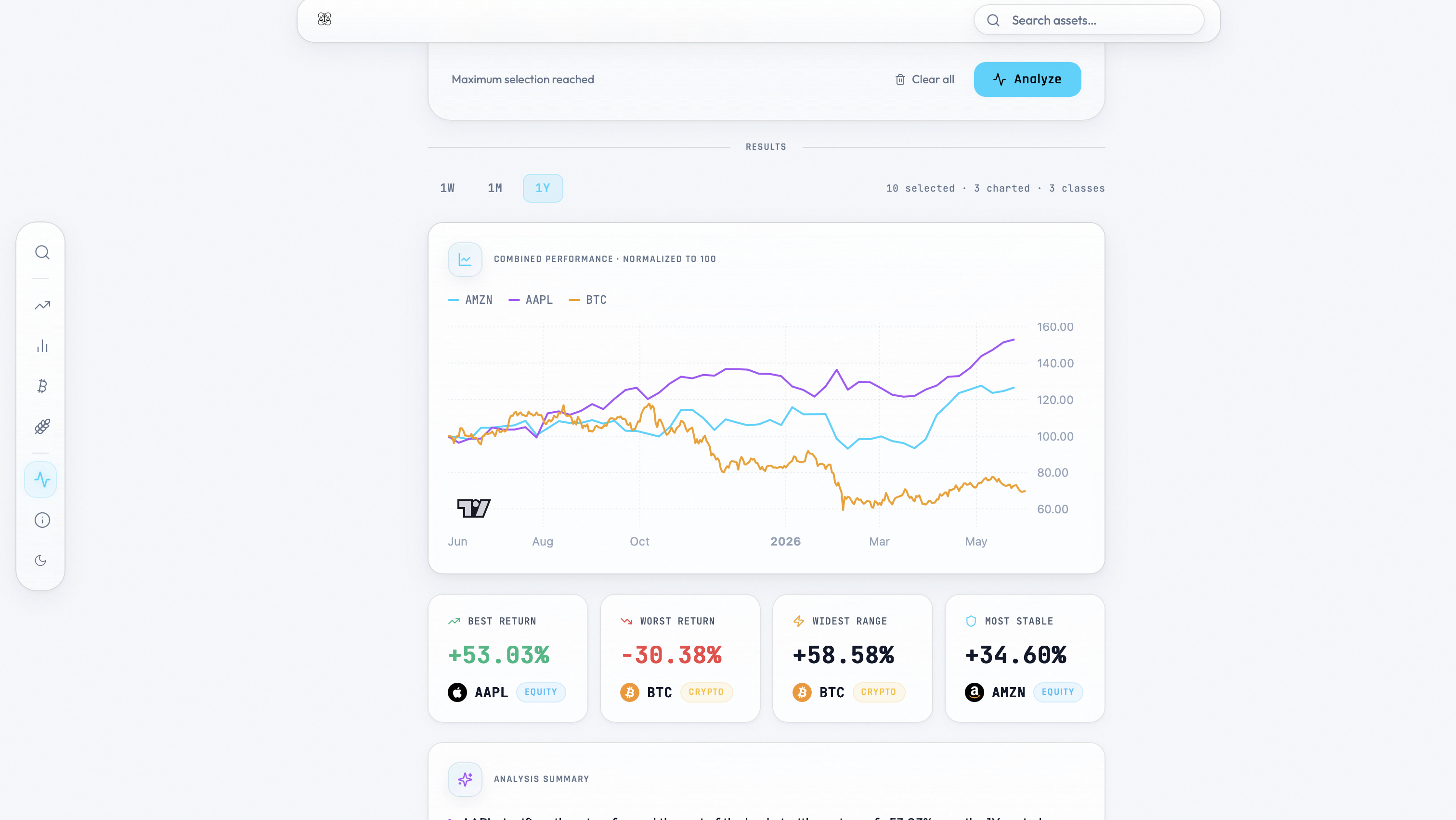
Why Cross-Asset Analysis Matters
Investment research often begins with a single asset.
A company, an ETF, a cryptocurrency, or a commodity captures an investor's attention and becomes the starting point for further analysis.
While this approach is common, it can also create blind spots.
Markets rarely move in isolation. Assets influence one another through economic conditions, monetary policy, investor sentiment, sector trends, and global events.
Understanding those relationships is where cross-asset analysis becomes valuable.
Looking Beyond Individual Assets
Many investors spend significant time analyzing a single security while overlooking the broader environment in which it operates.
A technology stock, for example, does not exist independently from:
- Broader equity markets
- Interest rate expectations
- Sector performance
- Exchange-traded fund flows
- Currency movements
- Investor risk appetite
The same principle applies across virtually every asset class.
Looking at only one asset can provide detail.
Looking across multiple assets often provides context.
Markets Are Increasingly Connected
The distinction between asset classes has become less rigid over time.
Movements in one market frequently influence behavior elsewhere.
Examples include:
- Equity weakness increasing demand for defensive assets
- Interest-rate expectations influencing both stocks and bonds
- Commodity price changes affecting corporate earnings
- Cryptocurrency sentiment influencing broader risk-taking behavior
Understanding these relationships helps investors build a more complete picture of market conditions.
Context Improves Decision-Making
Cross-asset analysis is not about predicting markets with certainty.
Instead, it helps investors ask better questions.
Rather than asking:
"What is this asset doing?"
The question becomes:
"How is this asset behaving relative to everything else?"
That distinction often reveals information that isolated analysis can miss.
The Importance of Relative Performance
Absolute performance tells part of the story.
Relative performance often tells the rest.
For example:
An asset gaining 5% may appear attractive on its own.
However, if comparable assets gained 15% over the same period, the conclusion changes.
Likewise, an asset declining during a broad market selloff may actually be demonstrating relative strength.